
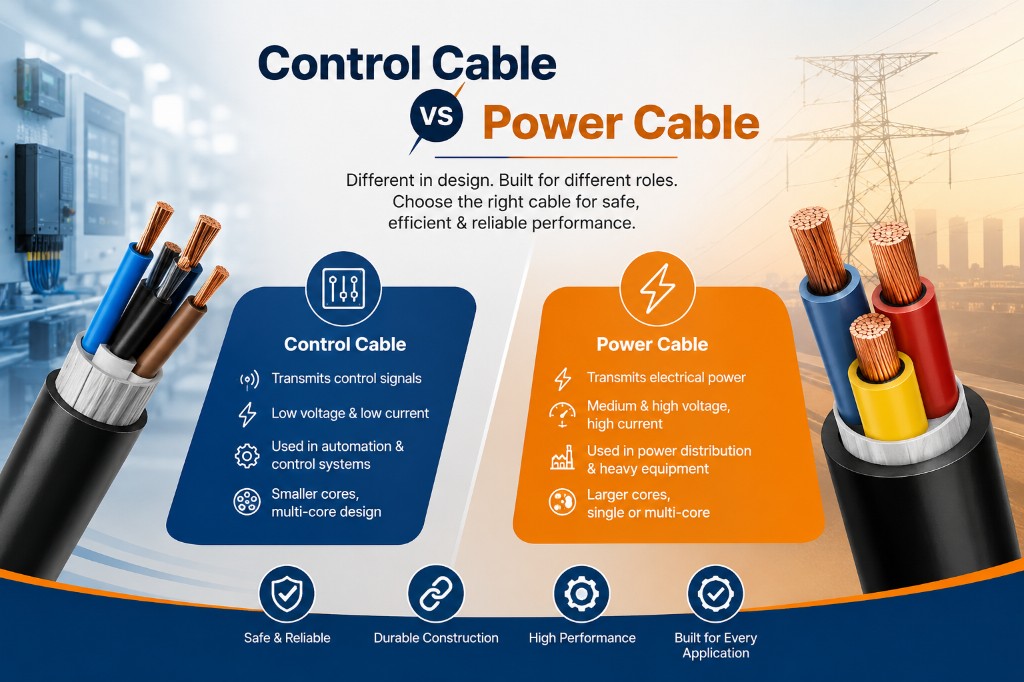
Control Cable vs Power Cable: Complete Comparison Guide for Industrial and Commercial Applications
Introduction
Electrical cables play a vital role in every industrial, commercial, and infrastructure project. Whether you are operating heavy machinery, managing an automated production line, or installing an electrical distribution system, selecting the correct cable directly impacts safety, efficiency, and equipment performance.
Among the most commonly used industrial cables are Control Cables and Power Cables. While they may appear similar, they are designed for entirely different functions. A power cable is responsible for transmitting electrical energy, whereas a control cable is used to carry low-voltage control signals that regulate, monitor, and automate electrical equipment.
Choosing the wrong cable can lead to poor system performance, unexpected downtime, increased maintenance costs, and safety concerns. Understanding the differences between these two cable types helps engineers, contractors, project managers, and buyers select the right solution for their specific application.
This guide explains the differences between control cables and power cables, their construction, applications, advantages, and selection criteria in simple, easy-to-understand language.
What is a Power Cable?
A Power Cable is an electrical cable specifically designed to transmit electrical energy from one point to another. These cables carry medium or high electrical loads and are used to supply power to motors, transformers, switchboards, distribution panels, generators, industrial machines, and electrical infrastructure.
Power cables are manufactured with larger conductors to safely carry higher currents while minimizing power losses. They are available in different voltage ratings and insulation materials depending on the installation environment and application.
Features of Power Cables
- Designed for transmitting electrical power
- Suitable for low, medium, and higher voltage applications
- High current carrying capacity
- Available with copper or aluminium conductors
- Strong insulation for electrical safety
- Excellent mechanical strength
- Long operational life
- Suitable for indoor, outdoor, and underground installations
What is a Control Cable?
A Control Cable is designed to transmit electrical control signals instead of electrical power. These cables connect various control devices such as switches, relays, sensors, programmable logic controllers (PLCs), instrumentation equipment, and automation systems.
Control cables ensure that machines receive accurate operating commands, making them an essential component in industrial automation and process control systems.
Unlike power cables, control cables carry very low electrical loads but require excellent signal integrity and reliability.
Control Cable vs Power Cable: Major Differences
| Parameter | Control Cable | Power Cable |
|---|---|---|
| Primary Function | Transmits control signals | Transmits electrical power |
| Voltage Level | Low voltage | Medium and higher voltage |
| Current Capacity | Low current | High current |
| Main Purpose | Equipment control | Power distribution |
| Core Size | Smaller conductors | Larger conductors |
| Construction | Usually multicore | Single-core or multicore |
| Typical Installation | Automation systems | Electrical distribution systems |
| Primary Users | Control equipment | Electrical equipment |
How Does a Power Cable Work?
Power cables transport electricity from the power source to electrical equipment. Their conductors are designed to provide low electrical resistance while carrying significant amounts of current safely.
The insulation surrounding the conductor prevents electrical leakage and protects the cable against heat, moisture, chemicals, and mechanical damage. Depending on the application, additional protective layers such as bedding, armouring, and outer sheathing may also be included.
Power cables are engineered to operate continuously under demanding electrical loads while maintaining efficiency and safety.
How Does a Control Cable Work?
Control cables transmit electrical signals between different control devices. These signals allow machines to start, stop, adjust speed, monitor operating conditions, or perform automated functions.
For example, when a sensor detects a change in temperature or pressure, the information is transmitted through a control cable to the control system. The controller processes the signal and instructs the connected equipment to perform the required action.
Although these cables do not carry heavy electrical loads, they are essential for maintaining accurate communication within automated systems.
Common Applications of Control Cables
Control cables are widely used in systems that require precise monitoring and control of electrical equipment.
Industries That Use Control Cables
- Industrial automation
- Manufacturing plants
- Robotics
- Process industries
- Machine tools
- Conveyor systems
- Packaging equipment
- HVAC control systems
- Chemical processing plants
- Oil and gas facilities
- Building management systems
- Water and wastewater treatment plants
These cables help ensure reliable communication between controllers and field devices.
Types of Power Cables
Power cables are manufactured in different designs to meet various installation requirements.
XLPE Insulated Power Cable
These cables offer excellent thermal performance, high dielectric strength, and long service life. They are widely used in industrial power distribution.
PVC Insulated Power Cable
PVC insulated cables provide reliable performance for standard electrical installations and are commonly used in commercial and residential applications.
Armoured Power Cable
Armoured cables include a protective metallic layer that safeguards the cable against mechanical damage during underground or exposed installations.
Unarmoured Power Cable
These cables are suitable for protected indoor environments where mechanical protection is not required.
How to Choose Between a Control Cable and a Power Cable
Selecting the correct cable depends entirely on the intended application.
Choose a Power Cable when:
- Electrical energy must be transmitted.
- High current loads are involved.
- Motors, transformers, or distribution panels require electrical supply.
- The installation is part of an electrical distribution network.
Choose a Control Cable when:
- Equipment requires signal transmission.
- Automation systems are involved.
- Sensors and controllers need reliable communication.
- Electrical commands must be transmitted accurately.
Understanding the operating requirements before selecting a cable helps improve system reliability and reduces future maintenance costs.
Important Factors to Consider Before Selecting a Cable
Several technical factors should be evaluated before choosing any industrial cable.
Voltage Rating
Always select a cable that matches the operating voltage of the system.
Current Capacity
Ensure the conductor size can safely carry the expected electrical load.
Installation Environment
Consider whether the cable will be installed indoors, outdoors, underground, or in industrial conditions.
Temperature Conditions
Choose insulation materials capable of withstanding the expected operating temperature.
Mechanical Protection
Where cables are exposed to physical impact, abrasion, or compression, additional protection may be required.
Flexibility
Applications involving continuous movement require cables designed for repeated bending.
Environmental Conditions
Exposure to moisture, chemicals, oils, sunlight, or dust should be considered when selecting insulation and sheath materials.
Which Cable is Better?
There is no universal answer because both cables serve different purposes.
A power cable is the right choice when electricity needs to be delivered efficiently and safely. A control cable is the correct option when equipment requires accurate communication and automated operation.
Instead of comparing which cable is better, the focus should be on selecting the cable that matches the operational requirements of the electrical system.
Conclusion
Control cables and power cables perform two distinct but equally important roles in modern electrical systems. While power cables are responsible for carrying electrical energy, control cables ensure that machinery and automated systems operate accurately through reliable signal transmission.
Understanding the differences in their design, voltage rating, applications, and performance characteristics allows engineers, contractors, and buyers to make informed decisions. Selecting the correct cable improves safety, enhances operational efficiency, minimizes maintenance, and increases the overall reliability of electrical installations.
Whether the project involves industrial automation, commercial infrastructure, manufacturing facilities, or power distribution, choosing the appropriate cable is an essential step toward achieving long-term performance and dependable operation.
Frequently Asked Questions (FAQs)
A control cable is used to transmit low-voltage control signals, whereas a power cable is designed to carry electrical energy to equipment and electrical systems.
No. Control cables are not designed to carry high electrical loads and should only be used for signal and control applications.
Power cables are commonly installed in electrical distribution systems, industrial plants, commercial buildings, renewable energy projects, substations, and manufacturing facilities.
Control cables are widely used in automation systems, PLC panels, sensors, relays, industrial machinery, robotics, and process control applications.
Power cables require larger conductors because they carry higher current and need to reduce electrical resistance and heat generation.
Yes. Most control cables are manufactured in multicore configurations to connect multiple control circuits within a single cable.
Control cables are generally more flexible because they are designed for routing through control panels, machinery, and automation equipment.
Yes. Power cables with suitable insulation and protective armouring are commonly installed underground for safe and reliable electrical distribution.
Cable selection depends on voltage, current load, installation environment, mechanical protection, operating temperature, and the specific function of the cable within the electrical system.
Yes. Most industrial facilities use both cable types together. Power cables supply electricity to equipment, while control cables transmit the signals required to operate and monitor that equipment effectively.