
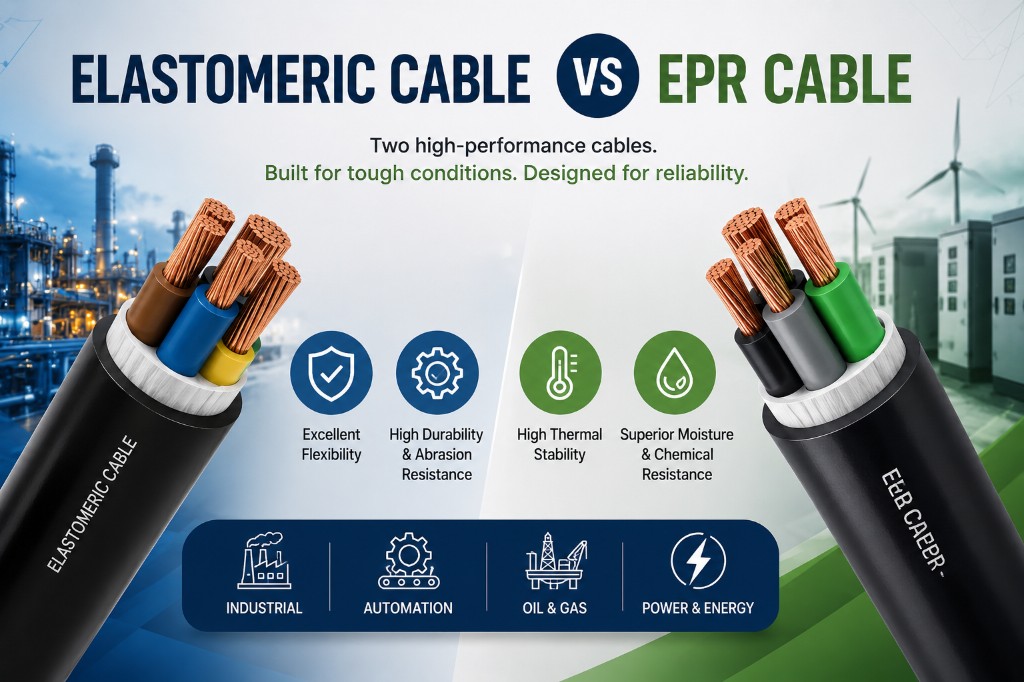
Elastomeric Cable vs EPR Cable: Complete Comparison Guide for Industrial Applications
Introduction
Selecting the right electrical cable is one of the most important decisions for any industrial, commercial, or infrastructure project. The cable you choose directly affects system performance, safety, durability, and maintenance costs. Among the many cable types available, Elastomeric Cables and EPR (Ethylene Propylene Rubber) Cables are widely used in industries where flexibility, heat resistance, and reliable performance are essential.
Although these two cable types are often compared, they are not identical. EPR is a type of elastomeric insulation, while the term elastomeric cable refers to a broader category of cables manufactured using various rubber-based insulating compounds. Understanding this distinction is essential when selecting the most suitable cable for demanding applications.
Both cable types are designed to perform in harsh environments, but their material composition, electrical properties, temperature ratings, flexibility, and applications can differ depending on the specific requirements of the project.
This comprehensive guide explains the differences between Elastomeric Cable vs EPR Cable, their construction, performance, advantages, and ideal applications to help engineers, contractors, procurement teams, and industrial buyers make an informed decision.
What is an Elastomeric Cable?
An Elastomeric Cable is an electrical cable insulated with synthetic rubber or elastomer-based compounds that provide excellent flexibility, durability, and environmental resistance. The term "elastomeric" refers to materials that can stretch and return to their original shape without permanent deformation.
These cables are designed to perform reliably under continuous movement, vibration, mechanical stress, moisture, oils, and extreme weather conditions. Their flexibility makes them suitable for applications where conventional PVC or XLPE cables may not provide sufficient durability.
Depending on the application, elastomeric cables may use different insulation materials such as EPR (Ethylene Propylene Rubber), CSP (Chlorosulfonated Polyethylene), Neoprene, or other specially formulated synthetic rubber compounds.
Key Features of Elastomeric Cables
- High flexibility for moving equipment
- Excellent resistance to abrasion and mechanical stress
- Reliable performance in harsh environments
- Resistant to moisture, oils, grease, and chemicals
- Suitable for indoor and outdoor installations
- Long operational life under demanding industrial conditions
- Performs well in both high and low temperatures
What is an EPR Cable?
An EPR Cable is a cable insulated specifically with Ethylene Propylene Rubber (EPR). EPR is a high-performance synthetic rubber compound known for its outstanding electrical insulation properties, excellent thermal stability, and superior moisture resistance.
Unlike general elastomeric insulation, EPR is engineered to provide consistent electrical performance under high temperatures and varying environmental conditions. This makes EPR cables a preferred choice for critical industrial applications where reliability and long service life are essential.
EPR insulation remains flexible even after years of operation and maintains its electrical characteristics under continuous thermal stress.
Key Features of EPR Cables
- Excellent dielectric strength
- High thermal stability
- Outstanding electrical insulation
- Superior moisture resistance
- Excellent flexibility
- Long service life
- Suitable for heavy-duty industrial environments
- Reliable performance under continuous electrical loading
Elastomeric Cable vs EPR Cable: Quick Comparison
| Feature | Elastomeric Cable | EPR Cable |
|---|---|---|
| Insulation Material | Various rubber-based elastomers | Ethylene Propylene Rubber (EPR) |
| Flexibility | Excellent | Excellent |
| Electrical Insulation | Very Good | Excellent |
| Temperature Resistance | High | Very High |
| Moisture Resistance | Excellent | Excellent |
| Chemical Resistance | Excellent | Excellent |
| Mechanical Strength | High | High |
| Industrial Applications | General heavy-duty applications | Critical electrical systems |
| Service Life | Long | Very Long |
| Cost | Moderate | Slightly Higher |
Construction of Elastomeric Cable
The construction of an elastomeric cable depends on its intended application, but most designs include multiple protective layers that ensure durability and reliable performance.
Conductor
High-quality copper conductors are generally used to provide excellent electrical conductivity and flexibility.
Elastomeric Insulation
The conductor is covered with a rubber-based insulating compound that protects against electrical leakage while maintaining flexibility under continuous movement.
Inner Sheath
An inner protective layer improves mechanical strength and provides additional insulation.
Armour (Optional)
Certain elastomeric cables include steel wire or steel tape armouring to protect against physical damage in harsh industrial environments.
Outer Sheath
The outer jacket protects the cable against moisture, abrasion, sunlight, oils, chemicals, and environmental exposure.
Construction of EPR Cable
EPR cables follow a similar construction but use Ethylene Propylene Rubber as the primary insulating material.
Copper or Aluminium Conductor
Depending on the application, conductors are manufactured using stranded copper or aluminium for efficient electrical transmission.
EPR Insulation
This layer provides excellent dielectric strength, heat resistance, and moisture protection while maintaining long-term flexibility.
Protective Fillers
Fillers maintain cable shape and improve mechanical stability.
Armour (When Required)
Industrial EPR cables may include armouring for underground or heavy-duty installations.
Outer Protective Sheath
The outer sheath protects the cable against abrasion, weather, oils, chemicals, and industrial contaminants.
Elastomeric Cable vs EPR Cable: Performance Comparison
Choosing between these cables depends on how they perform under actual operating conditions.
Flexibility
Both elastomeric and EPR cables are highly flexible, making them suitable for moving equipment and installations where repeated bending is common. However, EPR insulation generally retains its flexibility for a longer period under continuous thermal stress.
Temperature Resistance
Temperature resistance is one of the biggest strengths of both cable types.
Elastomeric cables perform reliably across a wide temperature range, making them suitable for general industrial environments. EPR cables, however, are specifically formulated to withstand higher continuous operating temperatures while maintaining stable electrical properties.
Electrical Performance
Electrical insulation is where EPR cables often have an advantage. Their higher dielectric strength reduces electrical losses and improves overall system reliability, especially in critical industrial installations.
Moisture Resistance
Both cable types offer excellent protection against moisture and humidity. Their rubber-based insulation prevents water ingress, making them suitable for outdoor and wet environments.
Chemical and Oil Resistance
Industrial facilities often expose cables to lubricants, chemicals, and oils. Elastomeric and EPR cables are both designed to resist chemical degradation, ensuring long-term performance even in demanding operating conditions.
Mechanical Durability
Both cable types provide excellent resistance to abrasion, vibration, and mechanical impact. Their robust construction makes them suitable for industries where cables are subjected to constant movement and heavy-duty service.
Frequently Asked Questions (FAQs)
An Elastomeric Cable is an electrical cable insulated with rubber-based materials that provide excellent flexibility, durability, and resistance to heat, moisture, oil, and mechanical stress.
An EPR Cable is an electrical cable insulated with Ethylene Propylene Rubber (EPR), offering excellent electrical insulation, heat resistance, and long-lasting performance in industrial applications.
An EPR Cable uses Ethylene Propylene Rubber as its insulation, while an Elastomeric Cable is a broader category that includes different types of rubber-based insulation materials. EPR is one type of elastomeric insulation.
Both cables are suitable for industrial use. Elastomeric Cables are preferred for flexibility and mechanical durability, while EPR Cables are ideal for applications requiring high electrical performance and heat resistance.
Yes. Elastomeric Cables are designed to perform well in high-temperature environments and maintain flexibility under demanding operating conditions.
EPR Cables are commonly used in power plants, industrial machinery, manufacturing units, renewable energy projects, mining, marine applications, and electrical distribution systems.
Yes. Both cable types are suitable for outdoor installations because they offer excellent resistance to moisture, sunlight, weather conditions, and environmental exposure.
Both cables provide excellent flexibility. However, Elastomeric Cables are generally preferred for applications involving continuous movement and frequent bending.
Choose the cable based on your application's voltage, temperature, flexibility, installation environment, and mechanical requirements. Selecting the right cable helps improve safety and performance.
Prestige Cable Industries manufactures high-quality industrial cables designed for reliable performance, durability, and safety. Every cable is produced with strict quality standards to meet the needs of various industrial applications.