
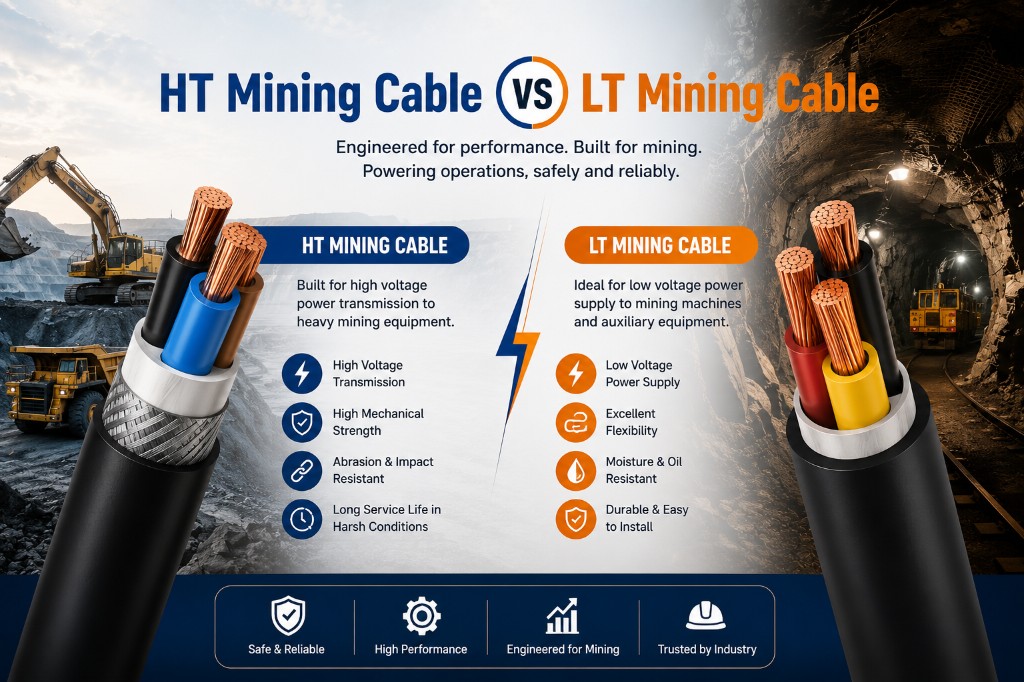
HT Mining Cable vs LT Mining Cable: Understanding the Key Differences for Mining Applications
Introduction
The mining industry operates in some of the toughest working environments, where electrical cables must withstand constant mechanical stress, moisture, dust, vibration, and heavy equipment movement. Choosing the right mining cable is essential for ensuring safe power transmission, reducing downtime, and maintaining efficient mining operations.
Among the various mining cables available, HT (High Tension) Mining Cables and LT (Low Tension) Mining Cables are the two most widely used categories. Although both are designed for mining applications, they differ significantly in voltage capacity, construction, performance, and intended use.
Selecting the wrong cable can lead to equipment failure, increased maintenance costs, and safety risks. Understanding the differences between HT Mining Cables and LT Mining Cables helps mining companies, contractors, and engineers choose the most suitable cable for their operations.
This guide explains the features, construction, applications, advantages, and major differences between HT Mining Cables and LT Mining Cables in a simple and practical way.
What is an HT Mining Cable?
An HT (High Tension) Mining Cable is designed to transmit electrical power at higher voltage levels to heavy mining equipment and large electrical installations. These cables are manufactured to operate safely under demanding conditions where high electrical loads and long-distance power transmission are required.
HT Mining Cables are commonly used to supply power to mining excavators, draglines, drilling machines, crushers, substations, and other heavy-duty equipment operating in underground and open-cast mines.
The robust construction of HT Mining Cables provides excellent resistance to abrasion, impact, moisture, chemicals, and harsh environmental conditions, making them suitable for continuous operation in challenging mining environments.
Features of HT Mining Cables
- Designed for high-voltage power transmission
- Excellent electrical insulation
- High mechanical strength
- Resistant to abrasion and impact
- Suitable for underground and surface mining
- Flexible construction for easier handling
- Long service life in harsh environments
- Reliable performance under heavy electrical loads
What is an LT Mining Cable?
An LT (Low Tension) Mining Cable is designed to transmit electrical power at lower voltage levels to mining equipment, machinery, lighting systems, pumps, conveyors, and auxiliary electrical installations.
These cables are ideal for applications where power distribution does not require high-voltage transmission but still demands excellent durability, flexibility, and resistance to mechanical damage.
LT Mining Cables are manufactured using high-quality conductors and rugged insulation materials to provide dependable performance in dusty, wet, and mechanically demanding environments.
Features of LT Mining Cables
- Suitable for low-voltage power distribution
- Excellent flexibility
- Durable outer sheath
- High resistance to moisture and oils
- Strong mechanical protection
- Easy installation
- Reliable electrical performance
- Suitable for fixed and mobile mining equipment
HT Mining Cable vs LT Mining Cable: Quick Comparison
| Feature | HT Mining Cable | LT Mining Cable |
|---|---|---|
| Voltage Rating | High Voltage | Low Voltage |
| Primary Purpose | Heavy power transmission | Low-voltage power supply |
| Typical Equipment | Excavators, draglines, substations | Pumps, conveyors, lighting, compressors |
| Electrical Load | Heavy | Moderate |
| Insulation Requirements | Higher | Standard industrial |
| Cable Construction | More robust | Flexible and durable |
| Installation Area | Large mining operations | Auxiliary mining systems |
| Cost | Higher | More economical |
| Maintenance | Low | Low |
| Service Life | Long | Long |
Construction of HT Mining Cable
HT Mining Cables are engineered to provide safe and reliable performance under continuous high-voltage operation.
Copper Conductor
High-conductivity stranded copper conductors ensure efficient electrical transmission while maintaining flexibility.
High-Performance Insulation
Premium insulation materials provide excellent dielectric strength, preventing electrical leakage and ensuring safe operation under high voltages.
Inner Protective Layer
An inner sheath enhances cable stability and provides additional protection against mechanical stress.
Armour (Where Required)
Many HT Mining Cables include protective armouring to withstand crushing, impact, and physical damage commonly encountered in mining operations.
Heavy-Duty Outer Sheath
The outer sheath protects the cable from abrasion, moisture, chemicals, sunlight, and harsh environmental conditions.
Construction of LT Mining Cable
LT Mining Cables follow a similar design philosophy but are optimized for lower-voltage applications.
Stranded Copper Conductors
Flexible stranded conductors provide efficient current flow while allowing easy installation.
Rubber or Elastomeric Insulation
Durable insulation materials provide excellent flexibility and resistance to environmental factors.
Protective Fillers
Fillers maintain cable shape and improve mechanical strength.
Outer Protective Sheath
The robust outer jacket protects against moisture, oils, abrasion, and mechanical damage.
Conclusion
Both HT Mining Cables and LT Mining Cables are essential for reliable mining operations, but they serve different purposes. HT Mining Cables are used for high-voltage power transmission to heavy mining equipment, while LT Mining Cables are designed for low-voltage power distribution to machinery and support systems. Choosing the right cable based on your voltage and application requirements ensures better safety, efficiency, and long-term performance. Prestige Cable Industries offers high-quality mining cables built to deliver dependable performance in demanding mining environments.
Frequently Asked Questions (FAQs)
HT Mining Cables are designed for high-voltage power transmission to heavy mining equipment, while LT Mining Cables are used for low-voltage power distribution to machinery, lighting, pumps, and other support systems.
HT Mining Cables are commonly used to supply power to large mining equipment such as excavators, draglines, crushers, drilling machines, substations, and other heavy-duty electrical installations.
LT Mining Cables are used for powering conveyors, pumps, compressors, lighting systems, ventilation equipment, workshops, and other low-voltage electrical applications in mining operations.
Both HT and LT Mining Cables are suitable for underground mining. The selection depends on the voltage requirement and the type of equipment being powered.
HT Mining Cables generally have thicker insulation and stronger construction to withstand higher electrical stress. However, both cable types are designed to offer excellent durability in harsh mining environments.
Although technically possible in some cases, HT Mining Cables are designed for high-voltage systems. Using an LT Mining Cable for low-voltage applications is usually more practical and cost-effective.
Important factors include voltage rating, current carrying capacity, installation conditions, flexibility, mechanical strength, moisture resistance, operating temperature, and the type of mining equipment being used.
Yes. Both HT and LT Mining Cables are manufactured with robust insulation and protective sheathing to resist moisture, abrasion, oil, chemicals, and mechanical damage commonly found in mining environments.
Choose an HT Mining Cable for high-voltage power transmission to heavy mining equipment. Select an LT Mining Cable for low-voltage distribution to auxiliary machinery, pumps, conveyors, and lighting systems.
Prestige Cable Industries manufactures high-quality HT and LT Mining Cables using advanced manufacturing processes and strict quality control. Our cables are engineered to deliver reliable performance, excellent durability, and long service life in demanding mining applications.