
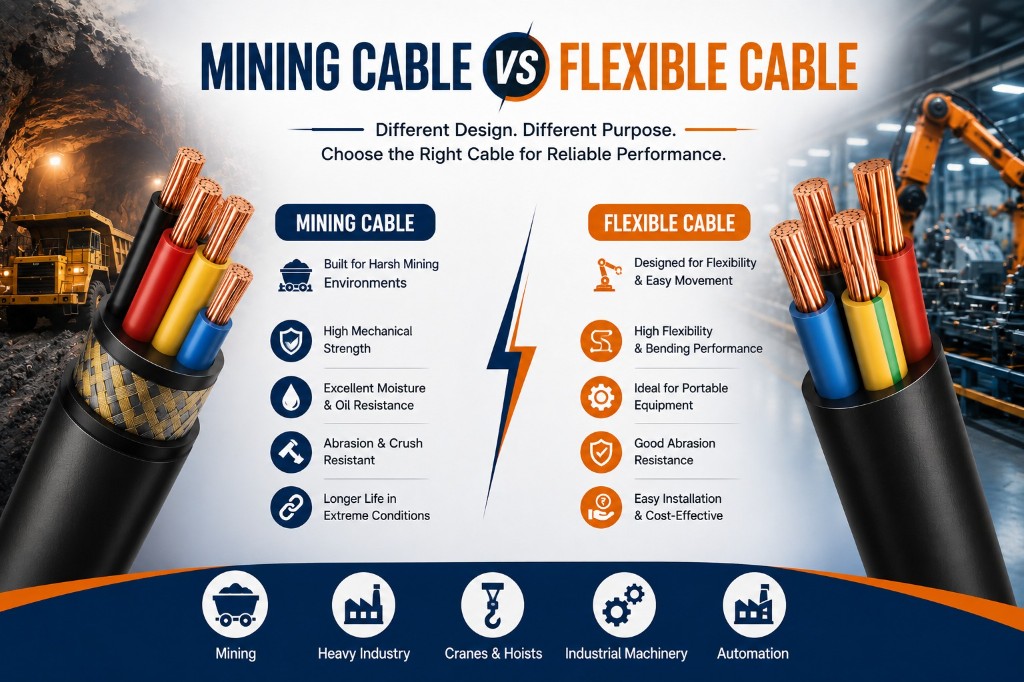
Mining Cable vs Flexible Cable: Key Differences, Applications & Which Cable is Better?
Selecting the right cable is essential for ensuring safety, reliability, and uninterrupted performance in industrial operations. Two commonly used cable types in heavy-duty applications are Mining Cables and Flexible Cables. Although both are designed to withstand demanding working environments, they are built for different purposes and operating conditions.
Mining Cables are specially engineered for underground and surface mining operations where cables are exposed to extreme mechanical stress, abrasion, moisture, chemicals, and continuous movement. Flexible Cables, on the other hand, are designed to provide maximum flexibility for portable electrical equipment, machinery, automation systems, and industrial applications where repeated bending and movement are common.
Understanding the differences between these cable types helps industries choose the most suitable cable for their operational requirements. This guide compares Mining Cables and Flexible Cables based on construction, durability, flexibility, performance, applications, and cost.
What is a Mining Cable?
A Mining Cable is a heavy-duty electrical cable specifically manufactured for the mining industry. These cables are designed to operate safely in harsh environments where exposure to moisture, dust, oil, chemicals, impact, crushing, and continuous mechanical stress is common.
Mining cables generally feature robust insulation, reinforced sheathing, and superior mechanical protection to ensure reliable power transmission in underground mines, open-pit mines, tunneling projects, and mineral processing plants.
What is a Flexible Cable?
A Flexible Cable is an electrical cable designed with finely stranded conductors that allow repeated bending, twisting, and movement without damaging the conductor or insulation. These cables are widely used where mobility and flexibility are essential.
Flexible cables are suitable for powering portable equipment, industrial machinery, cranes, hoists, robotics, automation systems, and temporary power installations.
Mining Cable vs Flexible Cable: Quick Comparison
| Parameter | Mining Cable | Flexible Cable |
|---|---|---|
| Primary Purpose | Mining operations | Portable equipment |
| Flexibility | Moderate | Excellent |
| Mechanical Strength | Excellent | Good |
| Abrasion Resistance | Excellent | Good |
| Crush Resistance | High | Moderate |
| Moisture Resistance | Excellent | Good |
| Oil Resistance | Excellent | Good |
| Chemical Resistance | High | Moderate |
| Durability | Very High | High |
| Installation | Heavy-duty | Easy |
| Cost | Higher | Moderate |
| Typical Industry | Mining | General Industrial |
Mining Cable vs Flexible Cable: Detailed Comparison
1. Construction of Mining Cable vs Flexible Cable
Mining cables are built with heavy-duty insulation, reinforced protective layers, and durable outer sheaths to withstand harsh mining environments.
Flexible cables use finely stranded copper conductors with flexible insulation that allows continuous movement without conductor damage.
2. Flexibility of Mining Cable vs Flexible Cable
Flexible cables are specifically designed for continuous bending and movement.
Mining cables also offer flexibility but prioritize mechanical protection over ease of bending.
3. Mechanical Strength of Mining Cable vs Flexible Cable
Mining cables provide outstanding resistance against impact, crushing, pulling, and abrasion.
Flexible cables can withstand normal industrial handling but are not intended for extreme mechanical abuse.
4. Abrasion Resistance of Mining Cable vs Flexible Cable
Mining operations involve rough surfaces, rocks, heavy equipment, and dragging of cables.
Mining cables feature highly abrasion-resistant outer sheaths to maximize service life.
Flexible cables provide good abrasion resistance but are designed primarily for controlled industrial environments.
5. Moisture Resistance of Mining Cable vs Flexible Cable
Mining environments are often wet and humid.
Mining cables are manufactured to perform reliably under continuous exposure to moisture.
Flexible cables also resist moisture but are generally intended for less demanding environments.
6. Chemical Resistance of Mining Cable vs Flexible Cable
Mining sites frequently expose cables to oils, fuels, acids, alkalis, and industrial chemicals.
Mining cables are engineered to withstand these harsh conditions.
Flexible cables provide good resistance to common industrial chemicals but may not offer the same level of protection.
7. Current Carrying Capacity of Mining Cable vs Flexible Cable
Mining cables are designed to supply power to large mining machinery requiring high electrical loads.
Flexible cables are available in various sizes and ratings but are commonly used for portable equipment and machinery.
8. Durability of Mining Cable vs Flexible Cable
Mining cables are manufactured for long-term operation under extreme working conditions.
Flexible cables offer excellent durability in applications involving repeated movement but may wear faster in highly abrasive environments.
9. Ease of Installation of Mining Cable vs Flexible Cable
Flexible cables are lighter, easier to handle, and simpler to install in applications requiring movement.
Mining cables are heavier because of their reinforced construction.
10. Cost of Mining Cable vs Flexible Cable
Mining cables generally cost more due to their specialized construction and enhanced protection.
Flexible cables are comparatively economical for standard industrial applications.
Why Choose Prestige Cable Industries?
Prestige Cable Industries has been manufacturing premium-quality industrial cables since 1988, serving industries across India with reliable cable solutions. Our mining cables and flexible cables are manufactured using high-quality raw materials, advanced production technology, and stringent quality control processes to ensure superior safety, durability, and long-term performance.
Whether your project requires heavy-duty mining cables or highly flexible industrial cables, Prestige Cable Industries offers dependable solutions designed to perform in demanding environments.
Conclusion of Mining Cable vs Flexible Cable
Both Mining Cables and Flexible Cables are essential for industrial power transmission, but they are designed for different operating conditions. Mining cables are ideal for harsh environments requiring exceptional mechanical strength, abrasion resistance, and long service life. Flexible cables are the preferred choice for portable machinery and applications involving continuous movement and repeated bending.
Choosing the right cable depends on your industry's operating conditions, equipment requirements, and environmental challenges. Evaluating these factors carefully ensures improved safety, operational efficiency, and long-term reliability.
Frequently Asked Questions (FAQs)
Mining cables are designed for harsh mining environments, while flexible cables are intended for applications requiring continuous movement and flexibility.
Mining cables are generally more durable due to their reinforced construction and superior resistance to abrasion, moisture, and mechanical stress.
Flexible cables may be used for certain portable mining equipment, but dedicated mining cables are recommended for heavy-duty mining applications.
Mining cables are manufactured with excellent moisture-resistant properties, making them suitable for wet mining environments.
Flexible cables are the preferred choice for portable machinery because of their high flexibility and bending endurance.
Mining cables use specialized insulation, reinforced sheathing, and heavy-duty construction, increasing their manufacturing cost.
Mining cables offer significantly better abrasion resistance than standard flexible cables.
Yes. Flexible cables are widely used in industrial automation, cranes, hoists, power tools, and manufacturing equipment.
Flexible cables are generally easier to install due to their lightweight and highly flexible construction.
Choose a mining cable for harsh environments and heavy machinery, while flexible cables are ideal for portable equipment and applications involving frequent movement.