
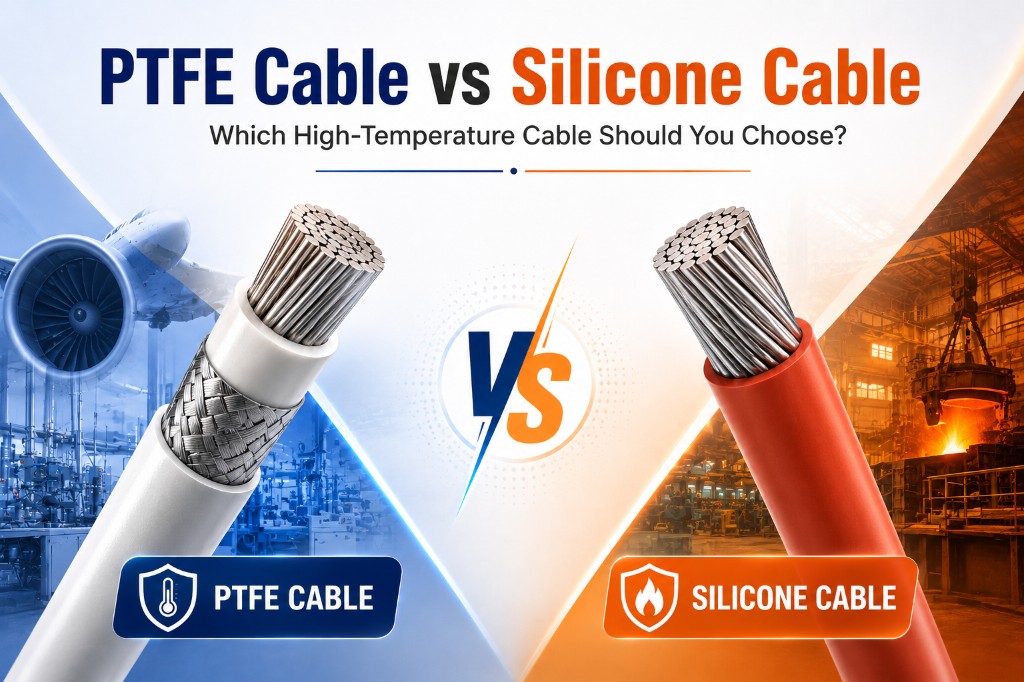
PTFE Cable vs Silicone Cable: Which High-Temperature Cable Should You Choose?
When an application pushes past the limits of ordinary PVC wiring, engineers usually land on two candidates: PTFE (Teflon) cable and silicone rubber insulated cable. Both are built for heat, both resist chemicals and flame far better than standard insulation, and both show up in industrial, aerospace, and heavy-machinery projects across India. But they are not interchangeable, and picking the wrong one can mean early insulation failure, wasted budget, or a cable that simply can't survive its operating environment.
This guide breaks down the real differences between PTFE cables and silicone rubber cables — temperature range, chemical behavior, flexibility, cost, and the industries each one actually belongs in — so you can specify the right cable the first time.
What Is a PTFE (Teflon) Cable?
A PTFE cable uses Polytetrafluoroethylene — the polymer most people know as Teflon — as its insulating layer. PTFE is a fluoropolymer prized for one thing above all: it barely reacts to anything. Heat, acids, solvents, fuels, and oxidizing chemicals all struggle to degrade it, which is why PTFE-insulated wiring shows up in aircraft harnesses, satellites, medical devices, and testing instruments where a failure simply isn't an option.
The trade-off is that PTFE is a harder, less rubbery material than silicone. It insulates beautifully and survives punishing conditions, but it doesn't flex quite as easily in tight bends, and manufacturing it into cable form is a more specialized process, which shows up in the price.
What Is a Silicone Rubber Insulated Cable?
Silicone rubber cable uses a soft, elastomeric silicone compound as insulation instead of a rigid fluoropolymer. That rubber-like quality is the defining feature: silicone cables stay pliable in cold weather, bend easily around machinery, and resist cracking from constant vibration or movement — something rigid insulations struggle with over time.
Silicone insulation also handles continuous high heat well, tolerates UV exposure and ozone, and resists moisture and general industrial contamination. It's the standard choice anywhere a cable needs to survive sustained heat while also being physically flexed, coiled, or routed through moving parts.
Side-by-Side Comparison Table
| Parameter | PTFE (Teflon) Cable | Silicone Rubber Cable |
|---|---|---|
| Operating temperature | -65°C to +260°C | -60°C to +180°C (higher for short bursts) |
| Chemical resistance | Outstanding — resists nearly all acids, solvents, fuels | Good — resists oils, moisture, general contaminants |
| Flexibility | Firm, less pliable | Highly flexible, rubber-like |
| Flame resistance | Self-extinguishing, very low smoke | Flame retardant, safe in fire-sensitive zones |
| Electrical insulation | Extremely high dielectric strength | Strong and stable, slightly lower than PTFE |
| Common voltage grades | 300/500V, 600/1000V, up to 1.1kV | 300/500V, 450/750V, 650/1100V, up to 1.1kV |
| Typical industries | Aerospace, defense, medical devices, precision electronics | Steel plants, cement, furnaces, foundries, textile machinery |
| Cost | Generally higher | Generally more economical |
| Best suited for | Extreme, corrosive, or mission-critical environments | Hot but mechanically active environments needing flexibility |
Temperature Performance: Where Each Cable Wins
Temperature is usually the first filter engineers apply, and it's also where the two materials diverge most clearly.
PTFE cable holds its insulation properties across an unusually wide band — from deep cold at -65°C up to +260°C — without cracking, melting, or losing dielectric strength. That range makes it suitable for environments with dramatic swings, like high-altitude aerospace wiring or equipment that cycles between cold storage and intense heat.
Silicone cable is engineered for continuous operation in the -60°C to +180°C range, with the ability to tolerate brief excursions above that in specific formulations. For furnace-adjacent wiring, steel plant machinery, or heating equipment that runs hot day after day, this range is more than sufficient — and the flexibility silicone brings to the table often matters more in these settings than an extra 80°C of headroom.
Chemical and Environmental Resistance
Both cables outperform PVC when chemicals are involved, but PTFE takes this category outright. Its molecular structure resists acids, alkalis, solvents, fuels, and industrial chemicals with almost no degradation, which is precisely why it dominates in chemical processing plants and lab environments where a single corrosive spill could otherwise compromise a cable's lifespan.
Silicone cable holds up well against oils, moisture, ozone, and general industrial exposure, and its UV resistance makes it a dependable option outdoors. It isn't built for aggressive chemical baths the way PTFE is, but for the moisture, dust, and mild contaminants typical of steel plants and heating equipment, it does the job reliably.
Flexibility and Mechanical Handling
This is where silicone earns its keep. Because it's a soft elastomer, silicone cable bends easily, tolerates vibration, and stays pliable even in cold conditions — useful anywhere a cable needs to move with machinery, coil into a compact panel, or route through tight, awkward paths without a specialist installer.
PTFE cable is firmer by comparison. It's still available in flexible, multi-core, and custom constructions, but it doesn't have the same rubbery give as silicone. In static or lightly-handled installations — aircraft harnesses, fixed instrumentation wiring — that firmness is a non-issue. In applications with constant movement or vibration, silicone's flexibility often makes it the more practical choice.
Electrical Insulation and Flame Safety
Both cable types offer high dielectric strength, low electrical losses, and genuine flame-retardant behavior, which is why both replace PVC in safety-conscious environments. PTFE edges ahead on raw dielectric performance and produces very little smoke when exposed to flame, a critical factor in enclosed spaces like aircraft cabins. Silicone's flame-retardant construction is also self-limiting and widely trusted in industrial settings, panels, and control systems where fire risk needs to be minimized without sacrificing flexibility.
Cost Considerations
Price depends on conductor material, insulation thickness, voltage rating, shielding, and order volume for both cable types — so a direct number isn't meaningful without a specification in hand. That said, PTFE cable typically carries a higher cost than silicone cable of comparable size, largely because fluoropolymer processing is more specialized. For projects where budget is a major constraint and the operating environment doesn't demand PTFE's extreme range or chemical resistance, silicone cable often delivers the better cost-to-performance ratio.
Which Industries Use Which Cable?
PTFE cable is the standard in:
- Aerospace and defense systems
- Medical device manufacturing
- Precision electronics and test instrumentation
- Power generation control systems
- Chemical processing plants requiring maximum resistance
Silicone rubber cable is the standard in:
- Steel and cement plants
- Furnaces and industrial heating equipment
- Foundries and metallurgical facilities
- Textile machinery
- Railway and renewable energy applications
- General industrial automation
How to Choose the Right Cable for Your Application
Ask these three questions before specifying either cable:
- What's the real temperature ceiling of my environment — and how often does it spike? If you need certainty above 180°C or exposure to sub-zero cycling, PTFE has the wider proven range.
- Will the cable be flexed, coiled, or vibrated regularly? If yes, silicone's rubber-like flexibility will likely outlast a firmer insulation in daily mechanical stress.
- Am I dealing with aggressive chemicals or a safety-critical, low-smoke requirement? PTFE's chemical inertness and minimal smoke output make it the safer specification for aerospace, defense, and chemical-heavy settings.
For most heavy industrial heat applications — furnaces, steel plants, cement units — silicone cable is the practical, cost-effective standard. For extreme, corrosive, or mission-critical environments, PTFE cable justifies its premium.
Prestige Cable Industries manufactures both PTFE (Teflon) cables and silicone rubber insulated cables in-house, with full testing and R&D support, so specifications can be matched precisely to your application rather than forced into a one-size-fits-all product.
Frequently Asked Questions (FAQs)
PTFE cable offers a wider temperature range and superior chemical resistance, while silicone cable offers greater flexibility and a more economical cost for general high-heat industrial use.
PTFE cable rates higher, operating from -65°C to +260°C, compared to silicone's typical -60°C to +180°C continuous range.
Generally yes. Silicone cable is usually more cost-effective than PTFE cable of similar size and rating, mainly due to differences in insulation material and manufacturing complexity.
Silicone cable is more flexible. Its rubber-like insulation bends easily and holds up well under vibration and repeated movement, while PTFE insulation is comparatively firmer.
Yes, PTFE insulation resists UV, moisture, and environmental degradation, making it suitable for outdoor and harsh-environment installations.
Yes, silicone's flexibility and resistance to cracking make it well-suited for machinery, foundries, and equipment subject to constant vibration.
PTFE cable is generally the better choice, since it resists acids, alkalis, solvents, and industrial chemicals more effectively than silicone insulation.
Yes, both cable types are inherently flame retardant, though PTFE typically produces less smoke when exposed to fire.
Both are commonly available in 300/500V and up to 1.1kV grades, with silicone also offered in 450/750V and 650/1100V configurations.
PTFE cable is the industry standard for aerospace and defense due to its extreme temperature tolerance, low smoke output, and superior dielectric performance.
Silicone rubber cable is typically preferred for furnace and steel plant environments because of its continuous high-heat performance combined with flexibility.
Yes, both cable types can be customized in conductor material, insulation thickness, shielding, voltage rating, and core configuration to match specific project requirements.
Looking for a manufacturer that produces both PTFE and silicone rubber insulated cables under one roof, with in-house testing and R&D? Prestige Cable Industries has been manufacturing industrial and specialty cables in India since 1988, offering custom specifications for both cable types to match your exact application.