
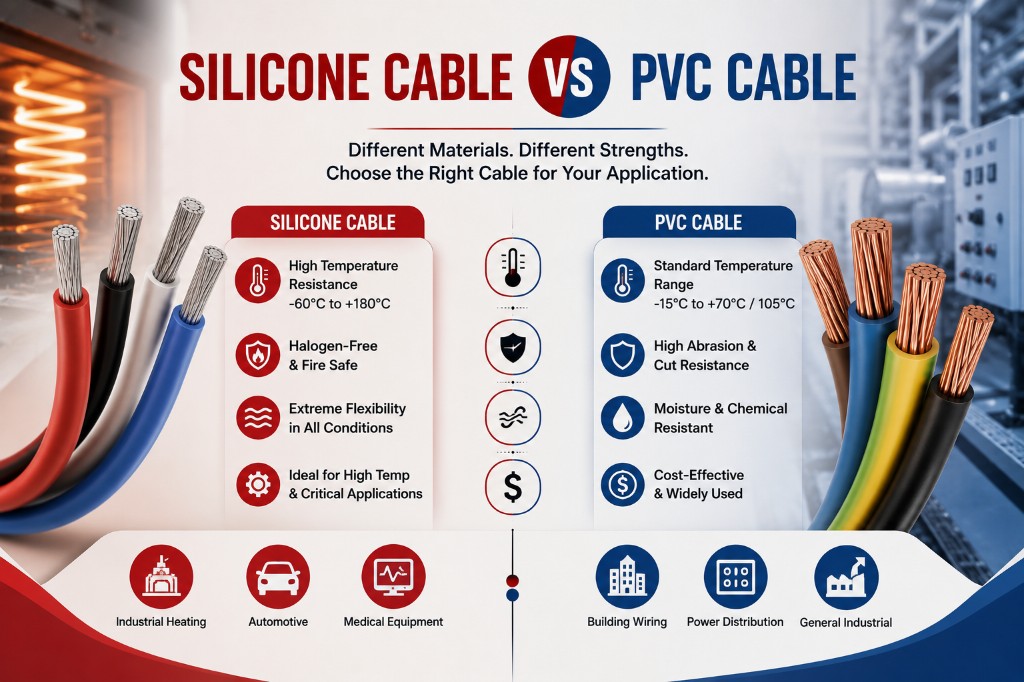
Silicone Cable vs. PVC Cable: Complete Comparison & Selection Guide
When selecting high-performance electrical cables for commercial, industrial, or residential projects, chosen insulation and jacketing materials directly affect long-term durability, safety, and electrical stability. Two of the most widely specified insulation materials across manufacturing and equipment wiring are Silicone Rubber and Polyvinyl Chloride (PVC).
While both cable types serve critical roles in power transmission and control systems, they possess fundamentally different chemical compositions, thermal thresholds, and mechanical characteristics. Installing a standard PVC cable in a high-temperature industrial environment can cause insulation melting and dangerous short circuits. Conversely, specifying silicone cables where high mechanical tensile strength or cost-efficiency is primary may lead to unnecessary expenditures.
In this technical guide from Prestige Cable Industries, we explore the differences between silicone cables and PVC cables—examining thermal endurance, flexibility, chemical resistance, safety performance, and application suitability.
What is a Silicone Cable?
A Silicone Cable is an ultra-flexible, high-temperature wire insulated and jacketed with synthetic silicone elastomer (silicone rubber). Silicone features a stable inorganic silicon-oxygen (Si-O) backbone, providing superior thermal stability, atmospheric resistance, and flexibility across extreme temperatures.
Key Characteristics of Silicone Cables
- Broad Temperature Range: Operates reliably from extreme freezing conditions of -60°C up to +180°C (with continuous endurance up to +200°C or higher for specialized formulations).
- High Hand Flexibility: Retains elasticity and softness even in freezing temperatures without cracking or stiffening.
- Halogen-Free & Fire Safety: When burned, silicone produces non-toxic, non-corrosive silica ash, releasing minimal smoke and zero halogen gases (LSZH properties).
- Dielectric Performance: Maintains high dielectric insulation properties over a wide temperature band, resisting electrical breakdown in demanding environments.
Common Applications of Silicone Cables
- High-temperature industrial furnaces, steel mills, and foundries
- Commercial heating equipment, ovens, and bakery machinery
- Automotive engine compartments, EV battery systems, and exhaust lines
- Medical instruments, autoclaves, and sterile processing units
- Lighting fixtures, halogen lamp wiring, and HVAC heating elements
What is a PVC Cable?
A PVC Cable is a versatile electrical cable insulated and jacketed with Polyvinyl Chloride, a widely used thermoplastic polymer. PVC compounds are blended with plasticizers, stabilizers, and flame retardants to yield balanced mechanical strength, moisture resistance, and cost efficiency.
Key Characteristics of PVC Cables
- Standard Temperature Band: Standard industrial PVC cables operate continuously between -15°C and +70°C, with heat-resistant PVC (HR-PVC) variants rated up to +90°C or +105°C.
- High Mechanical & Abrasion Resistance: The dense, rigid polymer matrix of PVC provides protection against abrasion, cut-through, tearing, and surface impacts.
- Moisture & Chemical Defense: PVC resists water, acids, alkalis, salts, and oils, making it ideal for indoor, outdoor, and underground installations.
- Cost Efficiency: Highly economical to produce and install, making PVC the default choice for building wiring and standard industrial machinery.
Common Applications of PVC Cables
- Residential, commercial, and industrial building wiring
- Low-voltage power distribution and control panels
- Household consumer appliances and power supply cords
- Underground cable trenching and conduit routing
- Machine tool interconnects and general factory wiring
Silicone Cable vs. PVC Cable: Core Differences Explained
1. Operating Temperature Ratings
- Silicone Cable: Engineered specifically for thermal extremes. Silicone rubber retains structural stability, softness, and electrical insulation from -60°C to +180°C (and up to +200°C continuously for premium grades).
- PVC Cable: Operates within a narrower thermal window (standard -15°C to +70°C; heat-resistant HR-PVC up to +105°C). Exposed to temperatures above its rating, PVC softens, deforms, and loses dielectric strength. Below freezing, PVC hardens and becomes prone to cracking under strain.
2. Flexibility and Mechanical Performance
- Silicone Cable: Demonstrates flexibility across its entire operating range. It bends around tight radii without physical strain, ideal for moving machine heads or tight enclosures. However, raw silicone rubber has lower tensile and tear strength than PVC, often requiring protective glass-fiber braiding in high-friction environments.
- PVC Cable: Offers high tensile strength, tough cut-through resistance, and surface durability. It withstands dragging, physical impacts, and mechanical compression better than unarmored silicone.
3. Fire Safety, Smoke, and Halogen Content
- Silicone Cable: Halogen-free by nature. When exposed to direct flame, it releases low-density, non-corrosive smoke. The remaining non-conductive ash maintains basic electrical separation during emergencies, supporting critical circuit preservation.
- PVC Cable: Contains chlorine (a halogen). While inherently flame-retardant and self-extinguishing, PVC releases dense black smoke and toxic hydrogen chloride (HCl) gas when burned in severe fires, which can corrode sensitive electronics and pose safety risks in enclosed spaces.
4. Resistance to Oils, Chemicals, and Weathering
- Silicone Cable: Resists UV radiation, ozone, oxygen, weathering, moisture, and atomic radiation. It resists dilute acids and alkalis, though continuous exposure to petroleum fuels and aromatic hydrocarbons may cause swelling unless specialized silicone compounds are used.
- PVC Cable: Highly resistant to water, oils, fuels, acids, and environmental moisture, rendering it suitable for direct-burial or wet-location conduits.
5. Cost and Installation Feasibility
- Silicone Cable: Raw silicone polymers and specialized manufacturing processes result in a higher initial purchase price compared to standard thermoplastics.
- PVC Cable: Cost-effective for volume installations, keeping project costs manageable across broad building and distribution networks.
Comparative Technical Summary
| Technical Parameter | Silicone Rubber Cable | Polyvinyl Chloride (PVC) Cable |
|---|---|---|
| Primary Insulation | Silicone Elastomer (Silicone Rubber) | Thermoplastic PVC Compound |
| Operating Temperature | -60°C to +180°C / +200°C | -15°C to +70°C (HR-PVC up to +105°C) |
| Flexibility Characteristic | Ultra-flexible; stays supple in freezing cold | Moderate flexibility; stiffens in extreme cold |
| Tear & Abrasion Resistance | Moderate (Enhanced with glass fiber braid) | High mechanical strength & cut-through resistance |
| Flame & Halogen Profile | Halogen-Free (Zero Halogen, Low Smoke) | Self-extinguishing; emits HCl gas on burning |
| Moisture Resistance | Excellent | Excellent |
| Chemical Resistance | Resists weathering, UV, ozone, dilute acids | Resists oils, fuels, acids, alkalis, solvents |
| Primary Advantage | Extreme thermal stability & flexibility | Cost-effective, high mechanical toughness |
When to Choose Silicone vs. PVC Cables
Selecting between silicone and PVC cables depends on evaluating operational parameters:
Select Silicone Cables If:
- Ambient temperatures consistently exceed +90°C or drop below -20°C.
- Cables require tight bending radii without hardening or stress cracking.
- Applications demand halogen-free, non-toxic smoke performance for public safety.
- Wiring is located near heating elements, furnaces, engines, or hot processing pipelines.
Select PVC Cables If:
- Installation takes place in standard ambient environments (-15°C to +70°C).
- Cables face physical dragging, mechanical crushing, or high-friction routing.
- Budget optimization is critical for large-scale wiring networks.
- Wiring requires resistance to petroleum oils, solvents, and direct underground moisture.
Why Partner with Prestige Cables for Industrial Wiring Solutions?
Prestige Cable Industries manufactures high-performance silicone and PVC cables engineered to meet international safety and performance standards.
The Prestige Advantage:
- High-Purity Conductors: Constructed using 99.99% pure electrolytic, soft-annealed copper for maximum current conductivity.
- Advanced Insulation Compounding: High-grade silicone compounds for thermal resilience alongside lead-free, flame-retardant PVC formulations.
- Quality Assurance: Manufactured under strict quality protocols, undergoing spark testing, high-voltage insulation tests, and thermal aging checks before shipment.
- Tailored Manufacturing: Core configurations, voltage grades, outer braidings, and sheath colors tailored to your project specifications.
Frequently Asked Questions (FAQs)
No. Standard PVC cables soften, degrade, and lose electrical insulation properties above +70°C (or +105°C for HR-PVC). Using PVC in high-heat zones above its rated limit can lead to short circuits, insulation melting, and electrical fires.
Silicone cables are halogen-free (LSZH). When exposed to fire, they emit low, non-corrosive smoke and leave a non-conductive ash layer. PVC cables are flame-retardant but contain chlorine, releasing dense black smoke and acidic hydrogen chloride (HCl) gas when burned.
Silicone’s molecular structure retains its elastic properties across extreme temperatures down to -60°C. Standard PVC becomes rigid and prone to cracking under mechanical stress in sub-zero conditions.
Raw silicone rubber has lower resistance to tearing, sharp cuts, and continuous mechanical abrasion than dense PVC. For environments with mechanical friction, silicone cables can be specified with an outer glass-fiber braid or protective armor.
Evaluate the operating temperature range, mechanical stress, exposure to oils or chemicals, fire safety requirements, and voltage load. The engineering team at Prestige Cable Industries can assist in selecting the appropriate cable configuration for your application.