
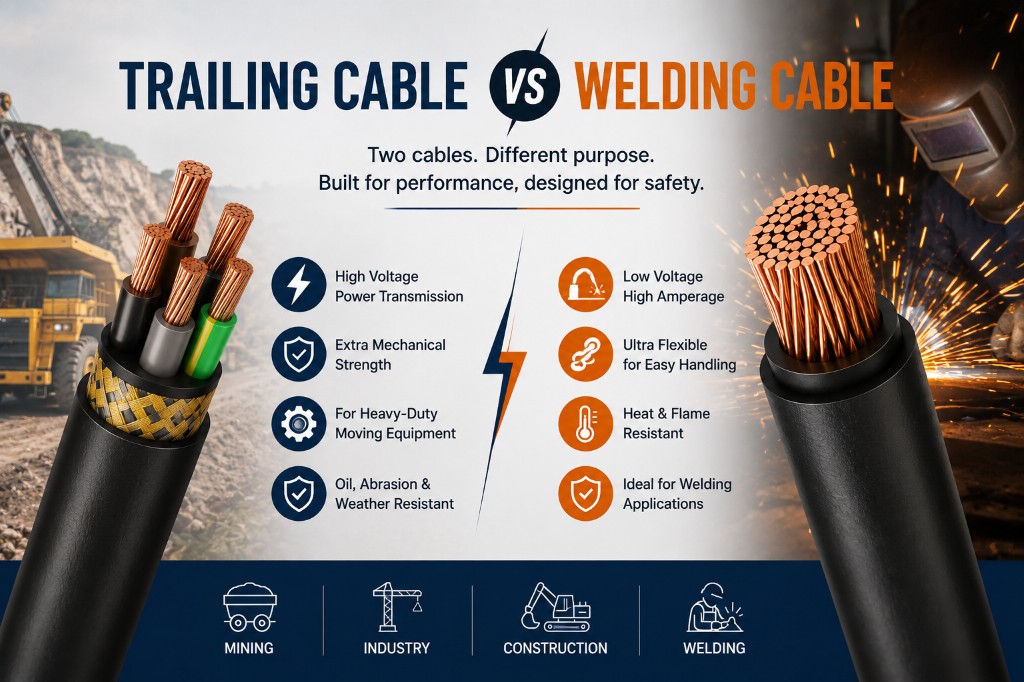
Trailing Cable vs. Welding Cable: Complete Technical Comparison & Selection Guide
Selecting the right heavy-duty electrical cable for industrial operations directly impacts equipment performance, worker safety, and overall project efficiency. In heavy manufacturing, mining, construction, and electrical installation, two flexible rubber cables are frequently mentioned together: Trailing Cables and Welding Cables.
While both cables utilize high-purity copper conductors and durable rubber sheathing to provide flexibility in tough environments, they are engineered for fundamentally different electrical, mechanical, and operational demands. Using a welding cable in a high-voltage trailing application—or vice versa—can lead to premature insulation breakdown, dangerous voltage leaks, and costly operational downtime.
In this guide from Prestige Cable Industries, we break down the key differences between trailing cables and welding cables, covering their internal construction, voltage capacities, sheath durability, and ideal application scenarios.
What is a Trailing Cable?
A trailing cable (often referred to as a rubber trailing cable or mining trailing cable) is a heavy-duty power delivery cable designed to supply continuous electrical power to mobile machinery and moving industrial equipment. These cables operate in environments where they are repeatedly dragged across rough surfaces, reeled onto drums, twisted, and exposed to extreme weather.
Key Characteristics of Trailing Cables
- High Voltage Handling: Trailing cables are designed for medium to high voltage power transmission. Voltage grades typically range from 1.1 kV (650/1100V) up to 3.3 kV, 6.6 kV, and 11 kV.
- Reinforced Mechanical Strength: To withstand relentless dragging, crushing forces, and mechanical tension, trailing cables incorporate thick, multi-layered jackets—often reinforced with an internal anti-twist steel or aramid (Kevlar) braid layer.
- Multi-Layer Sheathing: Built with Ethylene Propylene Rubber (EPR) insulation and polychloroprene (PCP) or Chlorosulfonated Polyethylene (CSPE) outer sheaths to resist oil, chemicals, UV rays, and ozone.
- Integrated Earth/Ground Cores: Most industrial trailing cables feature multiple insulated power cores along with dedicated earth (grounding) and pilot control cores for automated safety interlocks.
Common Applications of Trailing Cables
- Open-pit and underground mining machinery (electric shovels, draglines, haul trucks, drills)
- Overhead industrial cranes, hoists, and material handling conveyors
- Mobile equipment on construction and shipbuilding sites
- Heavy port machinery and container gantries
What is a Welding Cable?
A welding cable (or flexible welding lead) is a portable, ultra-flexible single-conductor cable specifically designed to convey secondary high-amperage current from an electric arc welding machine to the electrode holder and grounding clamp.
Key Characteristics of Welding Cables
- Extreme Hand Flexibility: Welder mobility requires maximum cable flexibility. Welding cables utilize thousands of extra-fine, soft-annealed copper strands (often 30 AWG / 34 AWG / 0.20 mm gauge) twisted tightly together.
- Low-Voltage, High-Amperage Capacity: Welding circuits operate at low output voltages (typically under 100V to 600V AC/DC) but carry massive electrical currents (from 100 to 600+ amperes).
- Thermoset Rubber Jacket: Covered in a tough EPDM (Ethylene Propylene Diene Monomer), Neoprene, or Nitrile rubber jacket that acts as both electrical insulation and environmental armor.
- Thermal & Flame Resistance: Engineered to withstand hot slag, welding sparks, chemical exposure, and brief contact with hot metal workpieces.
Common Applications of Welding Cables
- Electric arc welding systems (SMAW, MIG, TIG, Submerged Arc)
- Secondary battery bank interconnections and automotive starter leads
- Temporary low-voltage DC power distribution jumpers
- High-current industrial ground connections
Trailing Cable vs. Welding Cable: Core Differences Explained
Although both cable types fall under the category of flexible industrial rubber cables, comparing them side-by-side reveals sharp technical contrasts.
1. Voltage Rating and Power Transmission Capacity
- Trailing Cable: Designed for primary power delivery. They feature high dielectric strength insulation rated for 1.1 kV, 3.3 kV, 6.6 kV, or 11 kV circuits. They safely transport grid power across long distances to energized equipment.
- Welding Cable: Intended strictly for secondary output circuits. They are rated for low voltage operation—usually up to 100V, 250V, or 600V maximum. Applying primary medium-voltage power to a standard welding cable will result in electrical insulation failure and safety hazards.
2. Conductor Construction and Flexibility Needs
- Trailing Cable: While highly flexible compared to rigid armor cables, trailing cables prioritize structural stability over maximum wrist flexibility. Their copper strands are slightly thicker to maintain core integrity under severe dragging and twisting forces.
- Welding Cable: Prioritizes tactile flexibility above all else. Because welders continuously maneuver electrode handles by hand, welding cables use thousands of microscopic copper wire strands to keep the lead supple and minimize wrist fatigue.
3. Outer Sheath Material and Mechanical Resistance
- Trailing Cable: Features thick, heavy-duty thermoset rubber or polyurethane composite outer sheaths specifically formulated to withstand continuous dragging across sharp rocks, abrasive earth, and heavy oil spills.
- Welding Cable: Utilizes EPDM or Neoprene jackets engineered primarily for thermal endurance against hot weld splatter, sparks, and localized cuts. While abrasion-resistant, the single-layer jacket is thinner than the protective sheath of a trailing cable.
4. Tensile Reinforcement and Strain Protection
- Trailing Cable: Frequently subject to high pulling loads when mobile excavators or cranes reel and unreel the cable. Consequently, trailing cables contain an embedded internal braid layer made of textile, Kevlar, or tinned steel wire to absorb longitudinal tensile stress.
- Welding Cable: Does not feature tensile load reinforcement. Pulling a welding cable under extreme structural loads can stretch the soft copper strands and compromise the jacket.
5. Duty Cycle and Thermal Exposure
- Trailing Cable: Rated for continuous 100% duty cycle operation under steady nominal electrical loads.
- Welding Cable: Engineered around welding duty cycles (e.g., 20%, 60%, or 100% duty cycles in 10-minute intervals). The cable conductor is sized according to the welding machine’s output amperage and operating duration.
Comparative Technical Summary
| Feature / Parameter | Trailing Rubber Cable | Flexible Welding Cable |
|---|---|---|
| Primary Function | Continuous power supply to mobile machinery | Connecting welding machines to electrodes/earth |
| Voltage Rating | 1.1 kV, 3.3 kV, 6.6 kV, up to 11 kV | 100V, 250V, up to 600V |
| Conductor Type | Flexible stranded copper (Bare/Tinned) | Extra-fine stranded soft annealed copper |
| Number of Cores | Single or Multi-Core (Power + Earth + Pilot) | Typically Single Core |
| Tensile Strain Protection | Integrated Steel / Kevlar braid layer | None (designed for manual dragging only) |
| Sheathing Compound | EPR / PCP / CPE Heavy Elastomer | Heat-resistant EPDM / Neoprene / Nitrile |
| Special Resistance | High mechanical crushing, dragging & UV | Weld splatter, high heat, sparks & oil |
Can You Use a Welding Cable in Place of a Trailing Cable?
A common question among site managers is whether a flexible welding cable can be substituted for a trailing power cable due to its lower cost and high flexibility.
Safety Warning: Never substitute a standard welding cable for a trailing cable in high-voltage or heavy power distribution lines.
Here is why:
- Insulation Breakdown: Welding cable jackets are rated for low voltages (under 600V). Connecting them to 1.1kV or higher supply lines can cause dielectric puncture, resulting in electrical fires or severe shocks.
- Lack of Ground & Control Cores: Trailing cables integrate earth conductors and pilot wires necessary for safety breaker tripping. A single-conductor welding cable lacks these essential built-in protective features.
- Tensile Failure: Welding cables lack the Kevlar or steel anti-twist reinforcement found in trailing cables. Continuous reeling or dragging under heavy machine strain will stretch and break internal copper strands.
Conversely, using a trailing cable as a welding lead is inefficient because trailing cables are heavier, stiffer, and more expensive than specialized welding leads.
Why Choose Prestige Cables for Industrial Rubber Cable Solutions?
Prestige Cable Industries is a leading manufacturer, supplier, and exporter of industrial-grade rubber cables in India. Our comprehensive product portfolio includes high-performance Trailing Rubber Cables and Flexible Welding Cables engineered to meet strict international quality standards.
The Prestige Advantage:
- Premium Conductor Quality: We use 99.99% pure electrolytic copper for maximum electrical conductivity and thermal endurance.
- Advanced Rubber Formulation: Our trailing and welding cables feature high-grade EPR, EPDM, PCP, and CSP rubber sheathing tailored for high abrasion, chemical, oil, and flame resistance.
- Custom Voltage & Core Options: From single-core welding leads to multi-core 11 kV mining trailing cables, we offer customized lengths, color codes, and voltage grades.
- Rigorous Testing: Every cable manufactured at Prestige Cable Industries undergoes strict electrical insulation, tensile, and spark tests prior to dispatch.
Frequently Asked Questions (FAQs)
Trailing cables are multi-core power cables with heavy-duty outer rubber sheaths and embedded anti-twist tensile braids (Kevlar/steel) for high-voltage mobile machinery. Welding cables are single-core, low-voltage cables made of thousands of extra-fine copper strands designed for high hand flexibility during arc welding.
Prestige Cable Industries manufactures rubber trailing cables across several voltage grades, including 650/1100V (1.1 kV), 1.9/3.3 kV, 3.8/6.6 kV, and 6.35/11 kV, with custom high-voltage ratings available on request.
Yes, quality welding cables manufactured with EPDM or Neoprene rubber jackets are specifically engineered to resist oil, grease, hot weld splatter, sparks, and elevated temperatures encountered in fabrication environments.
Fine copper stranding gives the cable extreme flexibility. Because welders continuously move and bend the cable around workpieces, fine copper strands prevent fatigue, make the cable easy to maneuver, and reduce operator strain.
Cable selection depends on operating voltage, total current draw (amperage), ambient temperature, distance, and mechanical strain. For welding leads, match the cable square millimeter size (mm²) to the welding machine's maximum output amperage and duty cycle. For trailing power cables, consult Prestige Cables' engineering team to determine core count, voltage class, and required tensile reinforcement.