
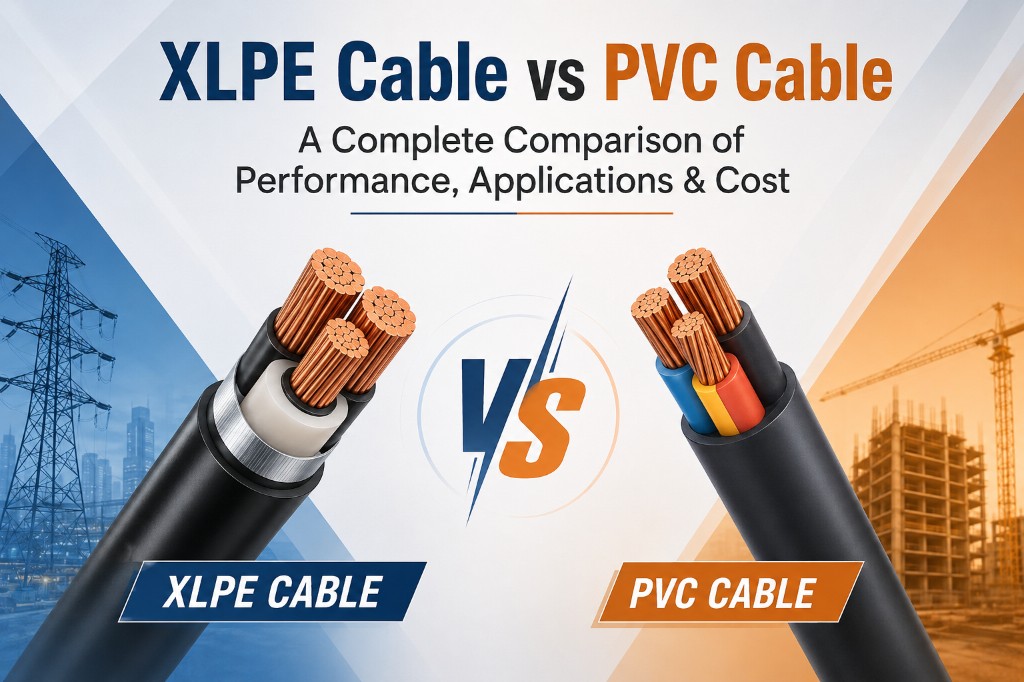
XLPE Cable vs PVC Cable: A Complete Comparison of Performance, Applications & Cost
XLPE Cable vs PVC Cable – Which One is Better?
When choosing an electrical cable, one of the most common questions engineers, contractors, and project owners ask is XLPE Cable vs PVC Cable – which one is the better choice? The answer depends on your application's voltage, operating temperature, environmental conditions, and performance requirements.
XLPE (Cross-Linked Polyethylene) cables are designed for demanding industrial and power distribution applications where higher temperature resistance, greater current carrying capacity, and longer service life are essential. PVC (Polyvinyl Chloride) cables, on the other hand, are economical, flexible, and widely used in residential, commercial, and light industrial electrical installations.
In simple terms, XLPE cables outperform PVC cables in terms of electrical performance, thermal stability, durability, and lifespan, while PVC cables remain the preferred option for cost-effective, low-voltage applications.
This comprehensive guide compares XLPE and PVC cables across every important parameter to help you select the right cable for your project.
What is an XLPE Cable?
An XLPE (Cross-Linked Polyethylene) Cable is an electrical cable insulated with chemically or physically cross-linked polyethylene. The cross-linking process changes the molecular structure of polyethylene, making the insulation significantly stronger, more heat-resistant, and mechanically durable than conventional thermoplastic insulation.
Because of these enhanced properties, XLPE cables are widely used in:
- Power transmission
- Power distribution networks
- Industrial plants
- Underground electrical systems
- Renewable energy projects
- Oil & Gas industries
- Steel and cement plants
- Infrastructure projects
XLPE insulation allows the cable to safely operate at higher temperatures while maintaining excellent electrical performance throughout its service life.
What is a PVC Cable?
A PVC (Polyvinyl Chloride) Cable is an electrical cable insulated with polyvinyl chloride, a versatile thermoplastic material known for its affordability, flexibility, and ease of manufacturing.
PVC cables are among the most commonly used electrical cables because they provide reliable insulation for low and medium-duty electrical applications.
Typical applications include:
- Residential wiring
- Commercial buildings
- Office complexes
- Lighting systems
- Control panels
- Electrical appliances
- Distribution boards
- Low-voltage power systems
PVC insulation offers good resistance to moisture, chemicals, and abrasion, making it suitable for everyday electrical installations.
XLPE Cable vs PVC Cable: Quick Comparison
| Parameter | XLPE Cable | PVC Cable |
|---|---|---|
| Insulation Material | Cross-Linked Polyethylene | Polyvinyl Chloride |
| Maximum Operating Temperature | Up to 90°C (higher under emergency conditions) | Up to 70°C |
| Current Carrying Capacity | Higher | Moderate |
| Electrical Performance | Excellent | Good |
| Heat Resistance | Excellent | Moderate |
| Mechanical Strength | High | Moderate |
| Chemical Resistance | Excellent | Good |
| Moisture Resistance | Excellent | Good |
| Lifespan | Longer | Moderate |
| Fire Performance | Better with suitable formulations | Standard fire-resistant grades available |
| Maintenance | Low | Moderate |
| Cost | Higher | Lower |
| Best For | Industrial & Power Distribution | Residential & Commercial Wiring |
XLPE Cable vs PVC Cable: Detailed Comparison
1. Insulation Material
The primary difference between these cables lies in the insulation.
XLPE insulation undergoes a cross-linking process that creates stronger molecular bonds, making the material resistant to deformation even at elevated temperatures.
PVC insulation is thermoplastic, meaning it softens when exposed to excessive heat. While it performs well in standard electrical installations, it is not intended for prolonged high-temperature environments.
2. Temperature Resistance
Temperature resistance directly affects cable performance and lifespan.
XLPE cables can continuously operate at 90°C, allowing them to carry more current without damaging the insulation. During emergency overload conditions, they can tolerate even higher temperatures for limited periods.
PVC cables generally operate safely up to 70°C. Continuous exposure beyond this range may reduce insulation life and affect performance.
For industries with high ambient temperatures, XLPE cables are the preferred choice.
3. Current Carrying Capacity
One of the biggest advantages of XLPE insulation is its ability to carry more electrical current.
Because XLPE withstands higher temperatures without deterioration, the conductor can safely transmit more current than an equivalent PVC cable.
Higher current carrying capacity means:
- Improved efficiency
- Reduced voltage drops
- Lower energy losses
- Better system reliability
PVC cables perform adequately in standard installations but are more limited in high-load applications.
4. Electrical Performance
Electrical insulation quality determines system safety and efficiency.
XLPE insulation offers:
- Higher insulation resistance
- Lower dielectric losses
- Better voltage withstand capability
- Stable electrical characteristics over time
PVC insulation provides reliable performance for everyday electrical systems but generally exhibits higher dielectric losses than XLPE.
For critical power systems, XLPE provides superior long-term performance.
5. Mechanical Strength
Industrial environments expose cables to vibration, pulling forces, bending, and mechanical stress.
XLPE insulation offers excellent resistance to:
- Compression
- Impact
- Abrasion
- Mechanical deformation
PVC insulation is flexible and easy to install but is generally less resistant to sustained mechanical stress.
For demanding industrial installations, XLPE provides greater durability.
6. Heat Resistance
Heat is one of the primary factors affecting cable life.
XLPE maintains its structural integrity under continuous high-temperature operation. This reduces insulation aging and improves long-term reliability.
PVC softens more easily under elevated temperatures, making it better suited for normal operating environments.
Where excessive heat is expected, XLPE cables significantly outperform PVC cables.
7. Fire Performance
Fire safety is a critical consideration in modern electrical installations.
Standard XLPE insulation is not inherently flame-retardant, but XLPE cables are commonly manufactured with flame-retardant or low-smoke, halogen-free outer sheaths for enhanced fire performance.
PVC cables also have flame-retardant grades and are widely used where building codes require them. However, when exposed to fire, conventional PVC can emit dense smoke and corrosive gases.
The actual fire performance depends on the cable construction and applicable standards, but for critical infrastructure, XLPE cables with suitable protective sheathing are often preferred.
8. Moisture Resistance
Electrical cables installed outdoors or underground are regularly exposed to moisture.
XLPE insulation has excellent moisture resistance and maintains its insulation properties even in humid environments.
PVC also offers good moisture resistance, making it suitable for most indoor and many outdoor applications, but XLPE generally provides greater long-term stability in demanding conditions.
9. Chemical Resistance
Industrial facilities often expose cables to oils, acids, alkalis, solvents, and other chemicals.
XLPE insulation has excellent resistance to many industrial chemicals, making it suitable for manufacturing plants, refineries, and processing industries.
PVC also resists many common chemicals but may not perform as well as XLPE under prolonged exposure to harsh industrial environments.
10. Lifespan and Durability
A cable's lifespan depends on insulation quality, operating temperature, and environmental conditions.
Because XLPE operates at higher temperatures with lower insulation degradation, it generally offers a longer service life when correctly installed and operated.
PVC cables provide reliable performance for standard installations but may age more quickly under continuous heat or heavy loading.
Winner: XLPE Cable
11. Installation and Flexibility
PVC cables are lightweight, flexible, and easy to install, making them ideal for residential and commercial wiring projects.
XLPE cables can be slightly stiffer due to the cross-linked insulation but remain suitable for a wide range of installations when proper handling practices are followed.
If ease of installation is the primary concern, PVC has an advantage.
12. Cost Comparison
PVC cables are generally more economical than XLPE cables, making them a practical choice for projects with standard electrical requirements and budget constraints.
XLPE cables have a higher initial cost because of their advanced insulation technology. However, their longer lifespan, lower maintenance requirements, and superior performance can reduce lifecycle costs in industrial and infrastructure projects.
Advantages of XLPE Cable
- Higher operating temperature capability
- Greater current carrying capacity
- Longer service life
- Excellent electrical insulation
- Superior mechanical strength
- Better moisture resistance
- Improved chemical resistance
- Lower maintenance requirements
- Suitable for underground installations
- Ideal for industrial and high-load applications
Why Choose Prestige Cable Industries?
Prestige Cable Industries has been manufacturing high-quality industrial cables since 1988, delivering reliable cable solutions for industries across India. With advanced manufacturing facilities, stringent quality control, and compliance with relevant Indian and international standards, the company offers cables designed for safety, durability, and consistent performance.
Whether you require XLPE power cables or PVC insulated cables, Prestige Cable Industries focuses on engineering products that meet demanding industrial and commercial requirements.
Conclusion
Both XLPE and PVC cables play an important role in modern electrical systems, but they serve different purposes. XLPE cables are the preferred choice for industrial applications, power distribution, underground networks, and environments requiring higher temperature resistance and longer service life. PVC cables remain an economical and dependable option for residential, commercial, and light-duty electrical installations.
Selecting the right cable depends on your project's operating conditions, electrical load, environmental exposure, and budget. Evaluating these factors carefully will help ensure a safe, efficient, and long-lasting electrical installation.
Frequently Asked Questions (FAQs)
XLPE cables use cross-linked polyethylene insulation, offering higher temperature resistance, greater current carrying capacity, and longer lifespan. PVC cables use polyvinyl chloride insulation and are commonly used for standard residential and commercial wiring.
XLPE cables generally have a longer service life because their insulation withstands higher temperatures and mechanical stress more effectively than PVC.
Yes. XLPE cables are widely used for underground power distribution due to their excellent moisture resistance, electrical performance, and durability.
The cross-linking manufacturing process and superior performance characteristics increase the production cost of XLPE cables.
Yes, provided they are designed for outdoor use and installed according to the manufacturer's recommendations and applicable standards.
XLPE cables generally have a higher current carrying capacity because they can operate safely at higher temperatures.
Yes. They are widely used in power plants, factories, refineries, renewable energy projects, and heavy industries.
PVC cables are commonly preferred for residential wiring because they are economical, flexible, and suitable for standard household electrical loads.
XLPE cables perform significantly better in high-temperature environments due to their cross-linked insulation structure.
Choose XLPE for heavy-duty, high-temperature, or industrial applications, and PVC for cost-effective residential or commercial installations with normal operating conditions.
Yes. Their lower dielectric losses and higher current carrying capacity can contribute to improved electrical efficiency in many applications.
XLPE cables generally require less maintenance over their service life because of their superior resistance to heat, moisture, and mechanical stress.